
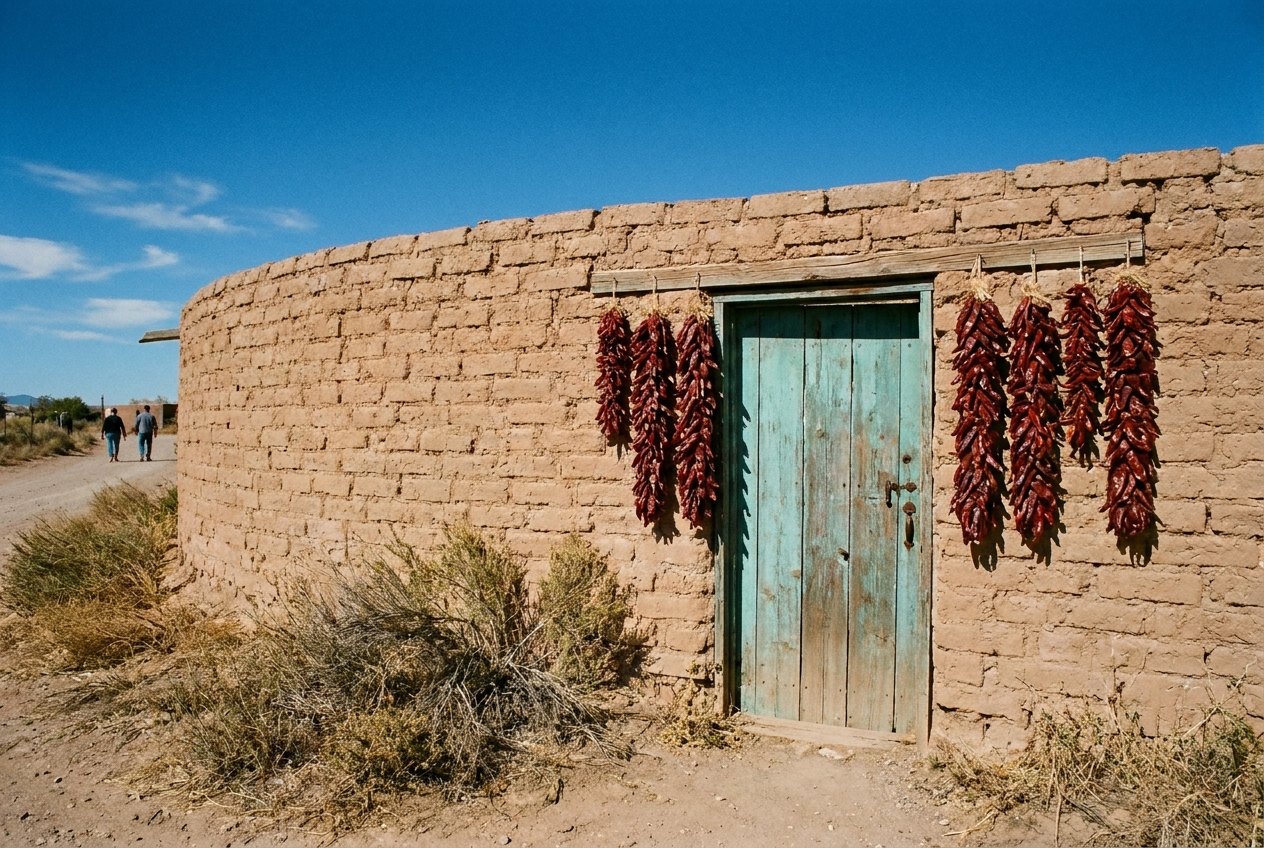
Santa Fe was founded by Spanish colonists in the early 17th century, around 1610, as the capital of the province of New Mexico, and it has been a capital ever since, under Spain, Mexico and the United States. It sits at about 2,100 metres, some 7,000 feet, at the foot of the Sangre de Cristo Mountains. Strict building rules keep most of the centre in the Pueblo Revival and Territorial styles: rounded adobe walls, flat roofs, wooden beams poking out of the walls, and doors painted blue or turquoise.
Day one: the Plaza
Start at the Plaza, the square at the heart of the old town, shaded by trees and busy from morning to evening. Along its north side runs the Palace of the Governors, a long, low adobe building with a wooden portal along its front. It was built in the early 17th century as the seat of the Spanish government and is often described as the oldest continuously occupied public building in the United States. Today it is part of the state history museum. Under its portal, Native American artists sell jewellery, pottery and other work they have made themselves, in a long-running programme with strict rules about who may sell and what.
A block east of the Plaza stands the Cathedral Basilica of St. Francis of Assisi, built of stone in the late 19th century in a French Romanesque style that stands out among the adobe. Inside, a small chapel holds a wooden statue of the Virgin brought from Spain in the 17th century.
A NOTE THAT FITS THE SAME TRIPYellowstone in one day: a loop that worksThe two chapels
South-east of the Plaza, the Loretto Chapel is known for its spiral wooden staircase, which makes two full turns up to the choir loft without an obvious central support. Who built it, and how, has been the subject of legend for more than a century. The chapel is now a private museum, and there is an entry fee.
A short walk further south, across the Santa Fe River, the San Miguel Chapel is a simple adobe church often described as the oldest church in the continental United States. It was first built in the early 17th century and rebuilt after the Pueblo Revolt of 1680. Inside, its old wooden altar screen and the bell in the small museum are worth a look.
Day two: Canyon Road and Museum Hill
Canyon Road climbs gently east from the centre along an old path that once led into the mountains. For about a kilometre, its adobe houses hold dozens of art galleries, with sculpture gardens, courtyards and studios. Walking up and back takes an afternoon if you look in a few doors. Many galleries are open daily, but some keep shorter hours early in the week.
Museum Hill, a few kilometres south-east of the centre, gathers several museums around a plaza with views of the mountains. The Museum of International Folk Art holds an enormous collection of toys, textiles and craft from around the world. Next door, the Museum of Indian Arts and Culture covers the history and art of the Native peoples of the Southwest. A bus and a walking trail link the hill with the centre. Back near the Plaza, the Georgia O'Keeffe Museum shows the work of the painter who made northern New Mexico her home.
Altitude and seasons
At Santa Fe's height, the sun is strong, the air is dry and you may feel short of breath on the first day. Drink plenty of water, use sunscreen and go easy at first. Summers are warm with afternoon thunderstorms in July and August; winters bring cold nights and some snow, and the Christmas season, with paper lanterns called farolitos lining the walls, is beautiful. Late spring and early autumn bring the mildest days for walking.
The New Mexico Rail Runner train connects Santa Fe with Albuquerque, which has the nearest large airport; check its timetable before relying on it. For more short American trips, see our notes on Pittsburgh and on making the most of a layover at O'Hare.