
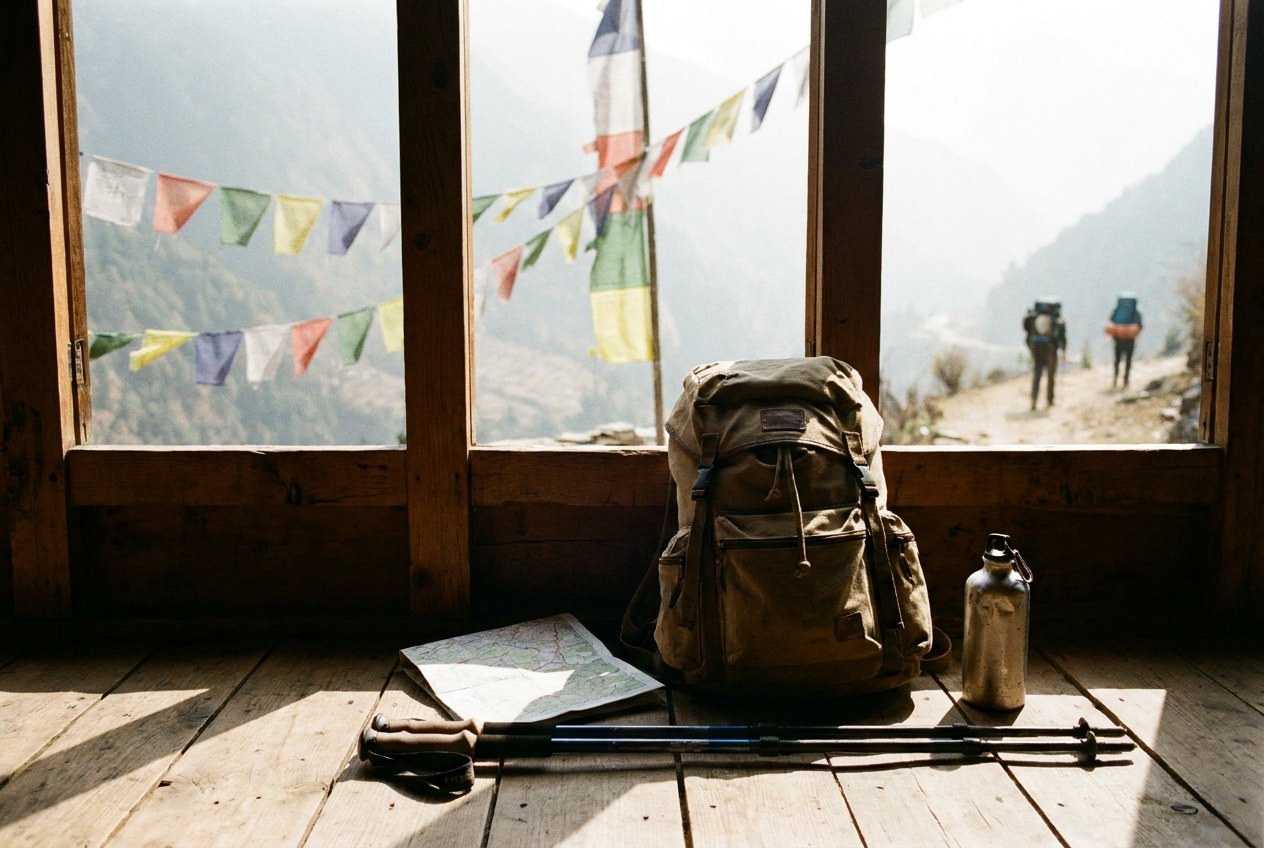
The classic trek to Everest Base Camp is a walk of roughly twelve to fourteen days there and back from Lukla, the small mountain airstrip that serves the Khumbu region of Nepal. It needs no climbing skills, but it climbs high, from about 2,800 metres at Lukla to more than 5,300 metres at Base Camp, and the planning revolves around two things: time for your body to adjust to altitude, and time for the weather to let planes fly.
Many people arrive in Kathmandu with nothing arranged beyond a hotel for the first night. That works well. The city has a long-established trekking industry, and arranging a trek after you land lets you meet the people you will walk with before you commit.
Book before or after you land
Booking ahead buys certainty: someone meets you at the airport, permits and flights are arranged, and the dates are fixed. Booking after landing gives you more choice and often a better feel for who you are dealing with. Both are reasonable. If you arrange things in Kathmandu, allow at least one full day for it, and do not hand over money until you know exactly what is included: flights, permits, accommodation along the trail, meals, a guide, a porter, and what happens if the flight is cancelled.
If you plan to walk with a guide, as many trekkers now must, read the notes in our page on guides and porters on the trail.
Permits
Two permits have been required for the Everest region in recent years: an entry permit for Sagarmatha National Park and a permit from the local rural municipality of the Khumbu. Carry several passport photos and photocopies of your passport; checkpoints along the trail will ask to see your permits.
The Lukla flight
The flight from Kathmandu to Lukla is short, spectacular and unreliable. The airstrip sits on a slope at the edge of a mountainside, and planes only fly in good visibility, usually early in the morning. Cloud, wind or rain can stop flights for a day or several days, and backlogs build quickly in busy seasons. In peak months, flights have often left from Ramechhap, a smaller airport several hours' drive from Kathmandu, instead of from the capital itself; check where your flight actually departs, because it can mean leaving Kathmandu in the middle of the night.
The flight from Kathmandu to Lukla is short, spectacular and unreliable.
There is an alternative that avoids the plane: a long drive by jeep to the Salleri or Phaplu area, followed by extra days of walking up to the main trail. It adds time but also adds lower-altitude walking days, which help acclimatisation, and it frees you from the airstrip's weather.
Whichever way you go in, keep two or three buffer days at the end of the trip before any international flight. Cancellations on the way out are just as common as on the way in.
A NOTE THAT FITS THE SAME TRIPAltitude and safety on the way to Base CampA typical route
Most itineraries follow the same line up the Dudh Koshi valley and into the Khumbu. From Lukla the first day is short, down to the river at Phakding. The second climbs steeply to Namche Bazaar, the main town of the region at about 3,440 metres, where nearly everyone takes a rest day. From there the trail continues via Tengboche, with its monastery and view of Everest and Ama Dablam, to Dingboche at about 4,400 metres for a second rest day, then on to Lobuche and Gorak Shep, the last settlement before Base Camp.
From Gorak Shep, most trekkers walk out to Base Camp itself on the edge of the Khumbu Glacier, and many climb Kala Patthar, a rocky hill above the village with a closer view of the summit of Everest than Base Camp offers. The way down is much faster, usually three or four days back to Lukla.
| Stage | Typical days |
|---|---|
| Lukla to Namche, with a rest day | 3 |
| Namche to Dingboche, with a rest day | 3 |
| Dingboche to Gorak Shep, Base Camp | 2 to 3 |
| Return to Lukla | 3 to 4 |
Gear and seasons
Thamel, the busy quarter of Kathmandu where most trekkers stay, is full of shops selling and renting trekking gear. Down jackets and sleeping bags are commonly rented there. Quality varies a great deal. Bring your own well-tested boots; new boots and two weeks of walking are a poor mix.
The best seasons are autumn, from October to November, after the monsoon has cleared the air, and spring, from March to May, when it is warmer and the rhododendrons flower at lower levels. Winter is possible but very cold higher up, and many lodges close. The summer monsoon brings cloud, rain, leeches lower down and frequent flight cancellations.
Finally, fitness matters more than gear. If you have a few months before you go, read our notes on training for the trek, and take out insurance that explicitly covers trekking above 5,000 metres and helicopter evacuation.